Spinal Cancer: Meet Sipra
Sipra Saha, an active 78-year-old woman who lives in Boca Raton, Florida, loves nothing more than having fun with her children and grandchildren. In January 2025, Sipra was bowling with her family when she suddenly lost her balance and fell to the ground. A few weeks later, when Sipra began experiencing neck pain, her son, Ted, a doctor, assumed the pain stemmed from her fall and took her to see a spine doctor. When imaging tests of her neck revealed a lytic lesion, an area of damaged bone often caused by cancer, Sipra and Ted were completely surprised.
“The lytic lesion was basically a hole in my mother’s cervical spine and would not have resulted from an injury due to a fall,” says Ted. “We realized this was a cancer that had been there for some time, but it had been completely undetectable until she had the imaging tests.”
Realizing there was no time to waste, Ted immediately began the journey of finding the best care for his mother. Sipra and Ted met with an oncologist and a neurosurgeon at Duke University in North Carolina who explained that due to the location of the lesion, the risks of getting a biopsy for a definitive diagnosis would outweigh the benefits. “The biopsy would have been a particularly morbid and invasive procedure,” says Ted. “She would have to have spine surgery in order to get the biopsy sample.”
An Extensive Search Leads to the New York Proton Center
Sipra’s doctors had a strong suspicion based on her imaging workup that the lesion was caused by a solitary plasmacytoma, a rare cancer that forms in either bone or soft tissue and is generally highly responsive to radiation therapy. After learning about different radiation therapy options, Ted realized proton therapy would be the best option because it delivers much more focused radiation therapy that conforms to the shape and depth of the tumor. In Sipra’s case, proton therapy could effectively treat her cancer and significantly reduce the amount of radiation delivered to surrounding structures.
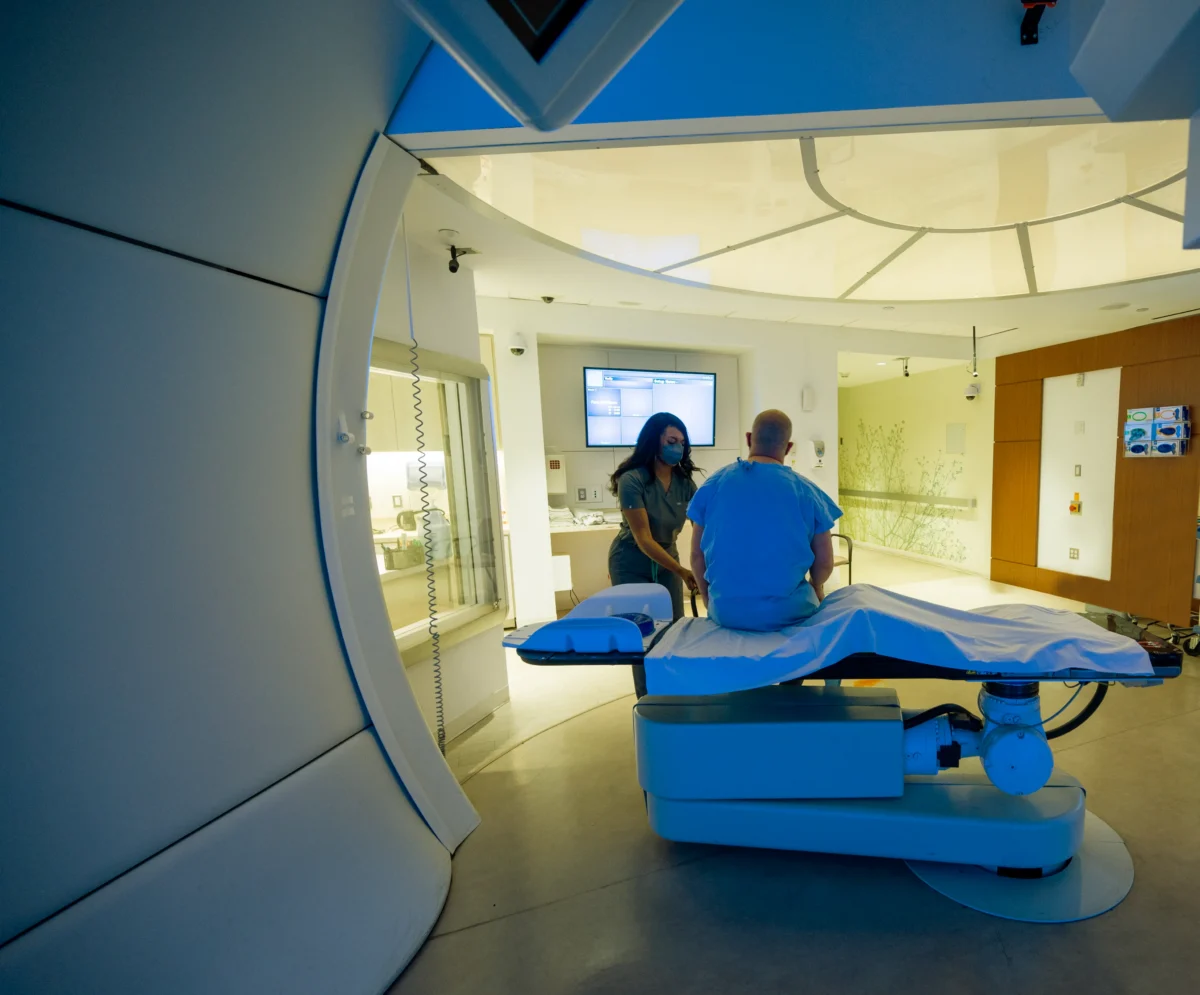
Ted quickly set out to find a proton therapy center that would fit his mother’s needs. “My mother was wearing a cervical collar to keep her neck stable, and we knew she would have to remove it during therapy,” explains Ted. “We were seeking a proton center that offered pencil beam scanning (an extremely narrow, magnetically steered beam of protons) and had machines with a 360-degree rotational gantry to reduce the need to reposition my mother and the amount of time she would be in the machine.”
Eventually, Ted was connected with Dr. Arpit Chhabra at the New York Proton Center. “We were able to meet with Dr. Chhabra very quickly,” says Ted. “He immediately realized what the problem was and within a week or two he and his team determined they would be able to help my mother.”
Precise Proton Therapy Minimizes Unnecessary Radiation
“Mrs. Saha had a lytic lesion that was felt to represent a plasmacytoma,” explains Dr. Chhabra. “We recommended she undergo proton therapy that would allow us to deliver a highly precise dose to the lesion while sparing normal tissues, particularly given the lesion’s proximity to the spinal cord, head and neck. Proton therapy would offer an excellent treatment approach by helping us balance tumor control with the goal of minimizing unnecessary radiation exposure to nearby sensitive anatomy.”
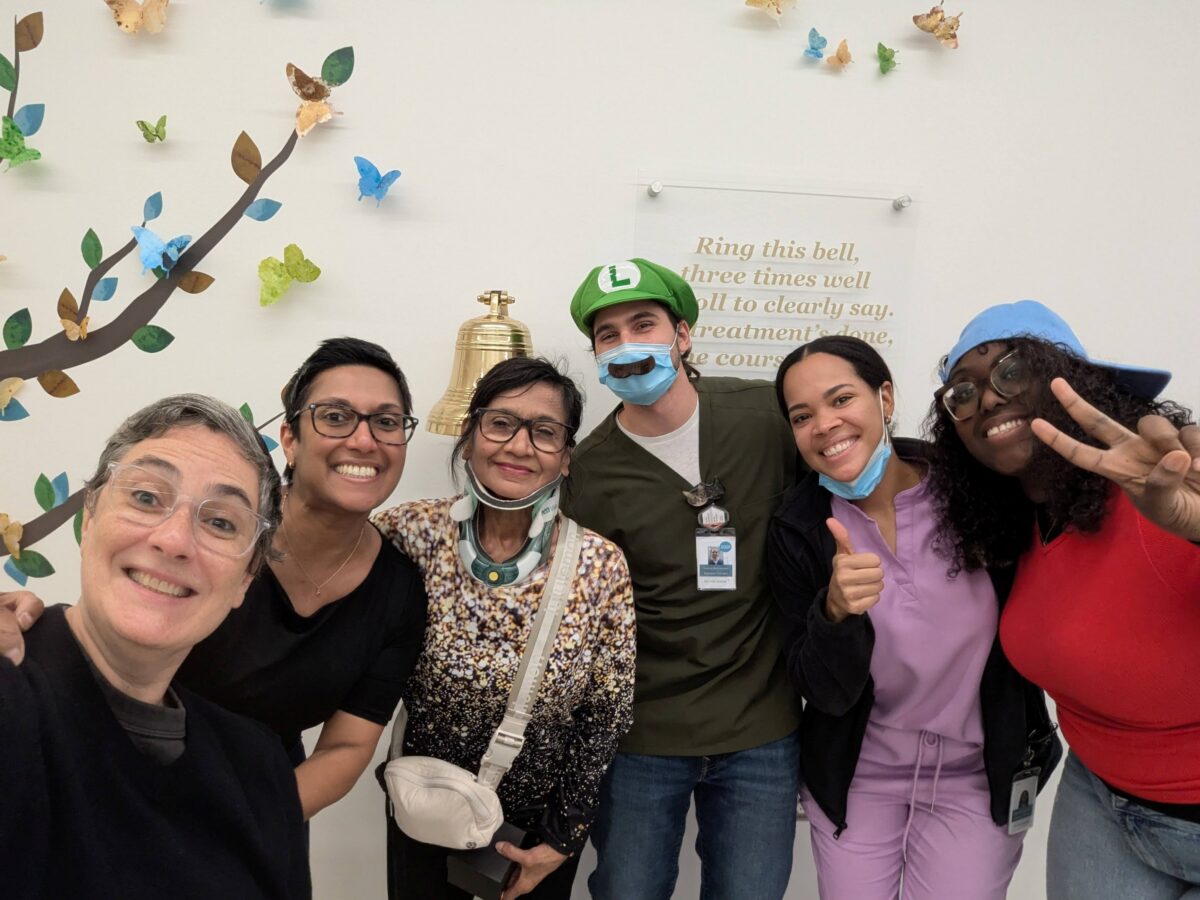
At the New York Proton Center, Sipra underwent five weeks of proton therapy. Her daughter Tina, who lives in New York City, accompanied her to the therapy sessions. “The scheduling of the sessions was excellent,” says Sipra. “I would have my proton therapy in the morning, and in the afternoon, Tina and her wife took me to museums and other fun sites in the city.”
“Throughout all five weeks of her therapy, my mother had enough energy to walk around and enjoy spending time with my sister and her wife,” says Ted. “The silver lining of this whole experience was that my mother got to experience New York as a tourist in a way that she never would have been able to do otherwise.”
Sipra experienced only minor side effects from the treatment including temporary loss of taste and a mild sore throat, both of which resolved within weeks of finishing treatment.

A Warm and Welcoming Environment
Reflecting on their experience at the New York Proton Center, Sipra and Ted were most appreciative of Dr. Chhabra’s and the team’s warmth and excellent communication. “From day one, talking to Dr. Chhabra was extremely reassuring,” says Ted. “It was a breath of fresh air to be able to talk to someone so easily. It was an incredible experience.”
“When I first met Dr. Chhabra, it seemed as if I already knew him so well, he seemed so familiar to me,” says Sipra. “I just love talking with him. He was so friendly. The care team was also very friendly and would always talk to me while I was waiting for my treatment.”
Now, six months past her treatment, Sipra has no signs of cancer. “The neurosurgeon was really impressed that he saw evidence of bone healing inside the cervical spine, which is very atypical so early after treatment,” says Ted.
“My mother has healed enough that she no longer needs to wear her cervical collar,” adds Ted. “She just rode a bike earlier today.”
“I feel really blessed that we found the New York Proton Center,” says Sipra. “It was an awesome experience. If anybody needs proton beam therapy, I would highly recommend they come here. This is the place to go.”